
How a St. Croix County Property Search Works
St. Croix County routes its documented property search through the Catalis public tax portal. Enter a parcel number, an owner name, or a house number with street. The county's own advice is simple. Search one criterion at a time, and type less rather than more. Start with whatever identifier you already hold, then pull the remaining details from the result. Combining a name and an address in a single attempt tends to backfire. The portal expects one field.
An address can return several candidate parcels. When it does, compare the municipality, the situs address, and the legal description. Only then settle on a match. Keep in mind that a tax mailing address may sit somewhere else entirely. It will not place the land itself. For map context, run the matched parcel through Beacon or COMPAS. Tapestry EON and Laredo serve a narrower purpose. Reach for them only when you need a recorded deed or another land instrument. The county publishes neither the vendor's exact field labels nor its oldest searchable year.
- Enter a parcel number, owner last and first name, or house number and street name in Catalis.
- Open the matching tax record and write down its parcel number, situs address, and tax year.
- Compare the public owner and mailing fields with the physical property address.
- Use Beacon or COMPAS to confirm the parcel's map location and municipality.
- Search the deed index or contact the Register of Deeds when you need the recorded instrument.
St. Croix County Property Search Fields
The county's Catalis instructions lay out three ways into the search. A guest result can be viewed without any checkout. Paying only comes later, if you select a record. Two limits are worth knowing. A transaction caps at ten parcels, the payment provider charges $1.50 for an e-check, and cards take a 2.99% fee. If your only goal is to inspect a parcel record, don't assume those vendor fees touch the guest search itself.
| Field | Type | Required | Format and next step |
|---|---|---|---|
| Parcel # / Property # | Text | Optional alternative | Use the parcel identifier; the county FAQ shows a no-dash form for the map. |
| Owner (Last and First Name) | Text | Optional alternative | Enter less when unsure; compare the returned situs address. |
| Address (House # and Street Name) | Text | Optional alternative | Use the property address, not the tax mailing address. |
| Search | Button | After one criterion | Run one search mode at a time. |
| Record checkbox / Add to Cart | Selection | For checkout | Choose a result before opening the cart. |
For a free guest lookup, use the Catalis property search. If the portal is down, call the Treasurer at 715-386-4645. Real Property Listing handles assessment and parcel questions. The county property-information page links out to the map and deed systems.
The county FAQ explains what a public tax address can and cannot reveal.
Read the St. Croix County owner and mailing-address FAQ
The tax address is public record. The county keeps no owner phone number or email, it says.
St. Croix County Search Result Details
No live Beacon parcel card is on display here. So the exact fields on a current St. Croix County result should not be guessed. A Town of Star Prairie tax bill from 2023 offers a solid sample instead. It shows what one property record can pull together. The owner and mailing block comes first. Then the situs address, bill number, parcel number, and an alternate parcel identifier follow. The legal-location description, acreage, and plat and lot details round it out. Value splits, ratios, credits, and installment terms fill the tax side of the bill. Read this as a sample bill inventory rather than proof that today's portal uses identical labels.
| Parcel identity | Bill 55562, parcel 038-1193-10-000, alternate identifier 13.31.18.996. |
|---|---|
| Location | Section 13, T31N, R18W, quarter-quarter, 1.800 acres, Pine Acres 2000, Lot 1. |
| Value | Land $29,600; improvements $171,800; total assessed $201,400; average ratio 0.6678. |
| Tax account | Credits, net tax, full payment, and installment amounts for the 2023 bill. |
The bill itself warns that its description may not be complete for legal purposes. When exact lot wording matters, turn to the recorded deed or survey reference and request an official copy. A tax search is a discovery step, never a substitute for the deed record itself.
St. Croix County Map Cross-Check
Carry the matched parcel number into Beacon or COMPAS. St. Croix County says Beacon carries aerial photographs plus one-foot contours. COMPAS can surface zoning permit documents through its "Laserfiche – Documents" table-of-contents checkbox. Layer names and identify controls vary, so the county GIS page is the dependable route. Ask GIS staff when a control is unclear. Do not mistake a map polygon for a survey. The county cautions that its GIS data is informational. It should be checked before any critical use. A plat or certified survey map ties subdivision lots back to the land record. Land Division handles preliminary mapping and town review. It also manages county Community Development review and final survey recording with the Register of Deeds. That process helps when an address sits near a municipal edge. It also helps when a parcel carries an older description. St. Croix County lists its viewers and statewide parcel-data routes.
Open the county GIS and land-information directory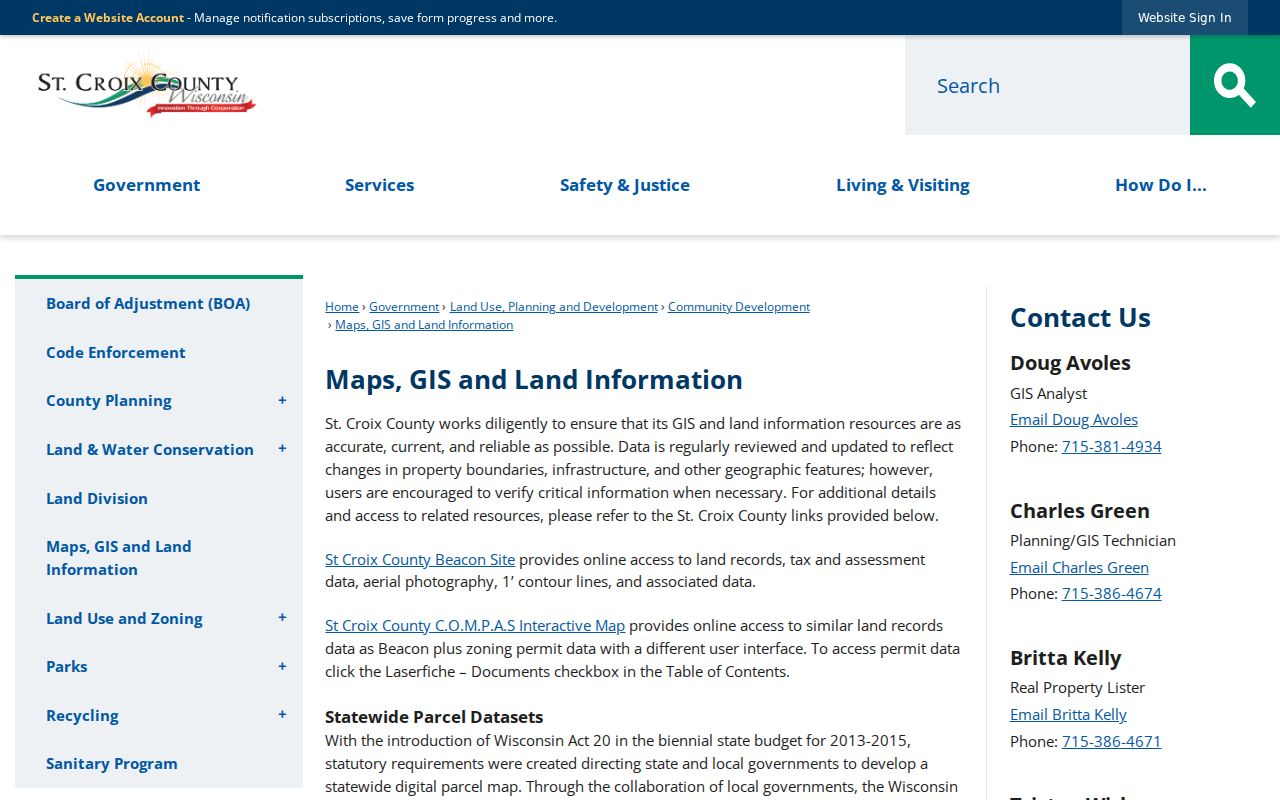
Use the map to confirm location. Then reach for a plat, survey, or CSM when legal dimensions matter.
Limits of a St. Croix County Search
A name alone is a weak search key in St. Croix County. Common surnames collide. So do LLCs, trusts, and estates. A spelling change can bury the record you want. Try initials first. Then try the entity's full legal name. Always confirm the location against both the parcel and the deed before trusting a hit. The exact indexing rules of the vendor deed index are not spelled out in the county's static pages. A stubborn name belongs at the Register of Deeds counter or on its phone line.
Wisconsin Public Records Law backs you up when a record never made it online. Send a focused request to the custodian instead of a broad one. Name the office, the parcel, the document type, and the date range. The DOJ points out that no fixed response deadline exists. The office must simply act as soon as practicable and without delay. Ask for a cost estimate if the search may run past $50. Do not request that the office build a database or answer an open-ended question.
Keep both parcel formats handy. The county FAQ shows a no-dash example for map work. The sample bill, though, prints an alternate parcel identifier too. Older records can carry a description that differs from today's portal.
What a St. Croix County Property Search Shows
A tax bill and an assessment record differ. A St. Croix County property search can surface both, and each record answers its own question. The 2023 Star Prairie bill, for instance, lists owner and mailing information, the property address, the bill number, and the parcel identifiers. It also shows the legal-location text, acreage, plat and lot, land and improvement values, the ratio, credits, and tax installments. The Beacon parcel card is another story. The county publishes no complete live inventory of it.
| Owner and mailing | Owner/taxpayer and the address used for the bill; tax addresses are public. |
|---|---|
| Situs | The address of the land, which can differ from the mailing address. |
| Parcel key | Parcel 038-1193-10-000 and alternate 13.31.18.996 in the sample bill. |
| Assessed value | Land, improvement, and total values for the stated tax year. |
| Legal location | Section-township-range, acreage, plat name, and lot when printed. |
| Sale / deed fields | Not verified in the sample tax bill; check the Register of Deeds index. |
A tax account is not a title report. Its legal description may be abbreviated. A vendor index is not the official office copy. For a transfer, rely on the newest recorded deed; for a boundary question, use a survey.
Choose a St. Croix County Search Key
The Catalis portal offers three search modes. Address suits someone who knows where the land sits but not its PIN. Owner name can turn up more than one parcel in St. Croix County, though each result still needs a situs check. A parcel number is the most direct key. It reliably returns to the same account. The FAQ's no-dash example works well for map searches. The tax bill shows alternate parcel formats can also appear.
| Search Key | Best For | Where It Works | Watch Out |
|---|---|---|---|
| Address | Find a known place | Catalis; Beacon or COMPAS for map context | Mailing address and situs may differ |
| Owner name | Find parcels associated with a name | Catalis; deed index for recorded parties | Common names and entities need location checks |
| Parcel number | Return to a specific account | Catalis and county map route | Keep dashes and alternate identifiers |
Not a title search. A St. Croix County property search can reveal county records, but it does not establish clear title. For a purchase or legal dispute, review the official deed and seek qualified title advice.
Save the PIN, tax year, and source URL. A short search note with those details lets another person repeat the same lookup and see which record version you used.
Resolve a St. Croix County Property Search Mismatch
A blank result is not the end of a St. Croix County property search. It usually means the terms, not the record, are off. Start with just the house number and street name. Then pull up the county map and look for a PIN there. The county FAQ notes one quirk worth knowing. A parcel ID that works on the map with dashes can also be entered as one unbroken string. Tax bills may list a second identifier next to the PIN. Record both instead of treating one as a mistake.
Owner-name searches can return a stack of parcels. Before opening any tax account, compare each situs address against the parcel map. Remember what each field means. Owner and mailing data describe the account holder and where the bill goes. The situs field is the property being assessed. The county provides the public tax address. It keeps no owner phone numbers or email addresses. A result is not a contact directory and says nothing about who lives there.
Always attach the tax year to any value or bill figure. The County Treasurer mails bills in mid-December, and assessments sit in year-specific accounts. A printed bill is not reissued automatically after a transfer. So a result naming a former owner deserves a closer look. Check the deed index for the recorded transfer date and weigh it against the bill date. The county tax-payment page handles current payment options. But it is no substitute for the recorded deed itself.
When an online result will not settle the question, take it to the office that keeps that record. Name a specific parcel and year. Give the search terms you tried. Include the property address and the PIN if you have it. Say whether you need an assessment card, a tax bill, or a recorded instrument. Wisconsin's open-records law does not force an office to build a new report or answer a vague question. A narrow request separates a truly missing record from a simple name or format mismatch.
Finally, treat a guest search and a paid checkout as two separate steps. Inspect the result first. Select no more than ten parcels per payment transaction. Review the vendor's displayed e-check or card fee before you submit. If no purchase is needed, keep the parcel reference handy. Then use the county's direct office or recorded-document route instead.