
St. Croix County Deed Records and What They Show
Deeds, mortgages, satisfactions, plats, certified survey maps, and federal tax liens all pass through the St. Croix County Register of Deeds. A recorded deed proves an instrument was filed. The index alone, however, is not a title opinion. The county's published material does not display the vendor's document-type dropdown, so the instrument groups described here are the standard categories rather than every label a searcher might meet in Tapestry or Laredo.
| Deed Type | What It Does | Common Use |
|---|---|---|
| Deed | Instrument recording a transfer of an interest in land | Search the grantor and grantee names, then inspect the document |
| Mortgage | Records a loan lien against the property | Check for later assignment, modification, or satisfaction |
| Satisfaction | Records that a mortgage debt has been paid | County FAQ says a satisfaction should be recorded rather than assumed |
| Plat or CSM | Maps a subdivision or land division | Use lot, block, and CSM reference with the legal description |
| Tax-deed quitclaim | County conveyance after a tax-deed sale | Review the sale terms and title limits before relying on it |
A deed conveys an interest in land. A mortgage or federal tax lien is an encumbrance instead. Satisfactions deserve special care. A paid debt does not vanish from the record simply because the payment cleared. The county urges owners to confirm the satisfaction was actually recorded. Search related names and later documents before treating any lien entry as current. The Register of Deeds access page identifies Tapestry EON and Laredo.
Review the county's land-record access choices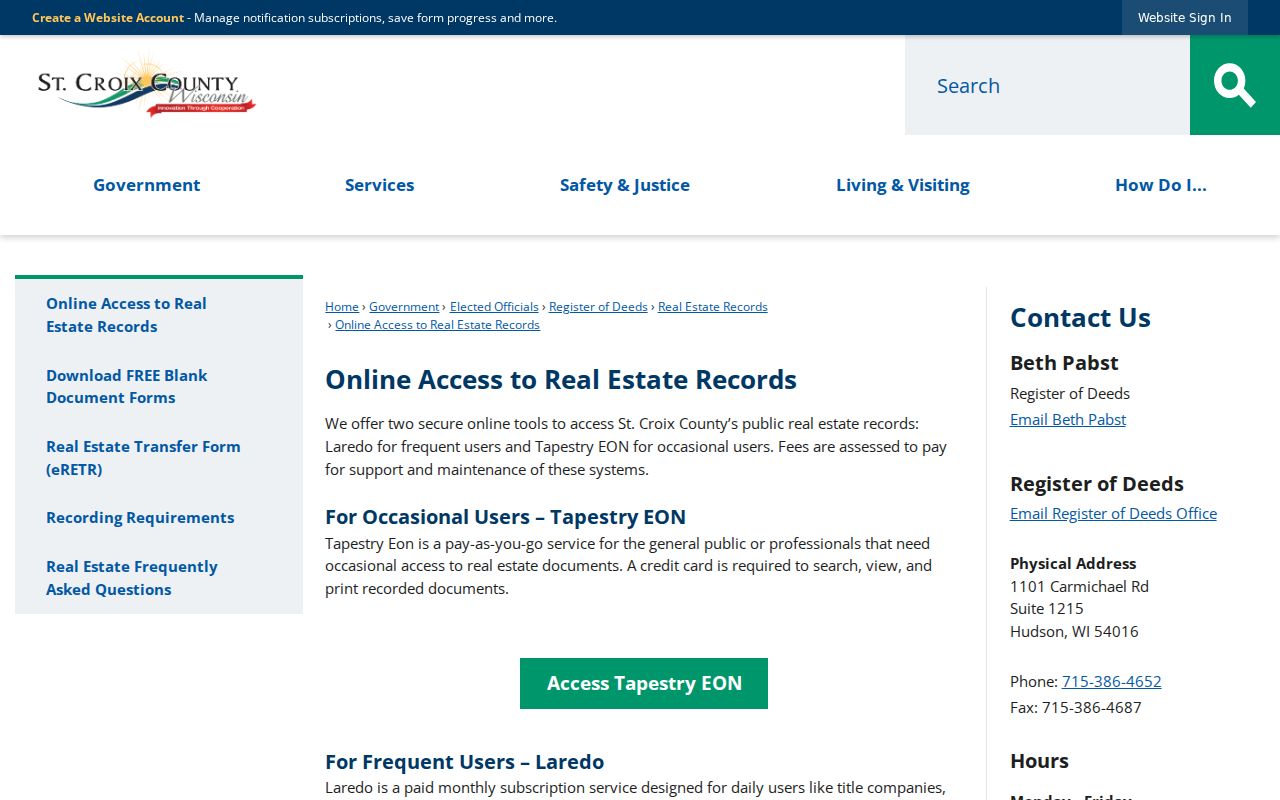
Choose the occasional-user or subscription route based on how often documents must be retrieved.
The St. Croix County Grantor-Grantee Index
In the grantor-grantee index, a grantor is the party conveying an interest. A grantee is the party receiving it. A chain of title is simply the ordered set of recorded transfers for one parcel. Building that chain works backward. Start with a known current deed, note its grantor, then hunt for the deed that vested title in that grantor earlier. Keep the legal description close at hand throughout. Names repeat, and a parcel's description can change over decades. The county's public material confirms this route. But it does not spell out every vendor field or indexing rule.
- Search the most recent known grantee name or parcel clue in the available land-record index.
- Read the instrument and copy the grantor, grantee, recording reference, and legal description.
- Search the grantor as a prior grantee to locate the deed that transferred the parcel to them.
- Repeat only while the legal description and parcel match; ask staff for older books or index help when the vendor search ends.
- Grantor
- The party conveying an interest in the recorded instrument.
- Grantee
- The party receiving the interest named in the instrument.
- Chain of title
- The sequence of deeds and related instruments that documents transfers.
- Book/page or document reference
- Record identifiers to copy exactly when requesting a paper or official copy.
St. Croix County Deed Recording Rules
New conveyances must meet Wisconsin's eRETR and recording requirements. The Register of Deeds expects a complete legal description and the county location. It also expects the matching eRETR receipt with any transfer fee due, and proper acknowledgment. A certified survey map reference must name the county and lot. It must also give the CSM volume, page, or document number. These are intake rules for recording. They are not fields guaranteed to surface in the public vendor search. A street address alone may not describe the land well enough. Keep the section, township, range, quarter-quarter, acreage, plat name, lot, and any CSM reference whenever they appear. The sample Star Prairie tax bill carries several of these pieces. But the county warns that a tax-bill description may fall short of a full legal description. When exact wording matters, rely on the recorded deed or survey instead. The county publishes its legal-description and eRETR requirements.
Read St. Croix County recording requirements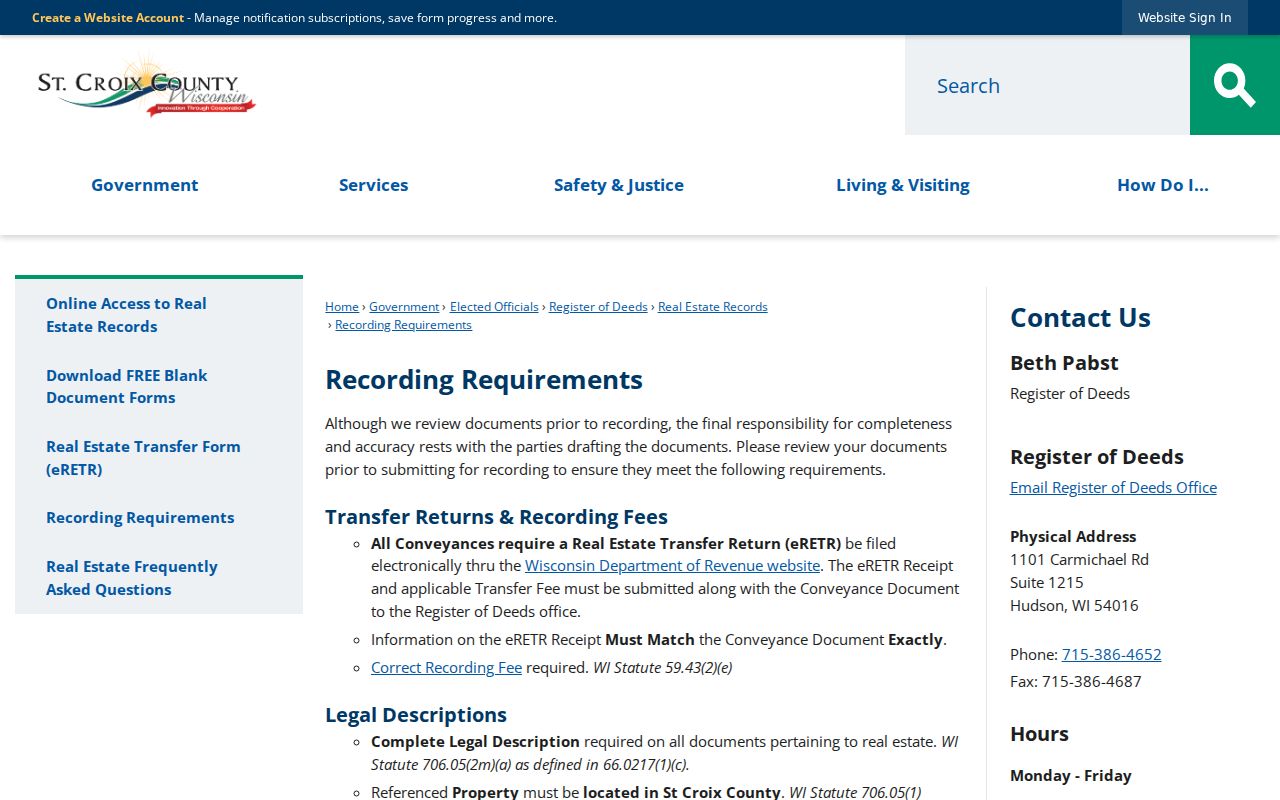
Use the county checklist before submitting a new conveyance or survey-related filing.
St. Croix County Deed Copy Fees
Recording and copy charges sit on separate lines of the county fee schedule. Recording runs $30 per document. Subdivision, cemetery, and condominium plats cost $50, while transportation project plats run $25. An uncertified letter or legal-size copy is $2 for the first page and $1 for each added page. Larger 11-by-17 copies cost $3 for the first page and $2 per additional page. Certification adds $1. Tapestry EON serves occasional users. Laredo suits frequent users and calls for an online access agreement, an escrow account, and a contract of at least three months. The county's page does not list the exact per-image price inside Tapestry. If an image is unavailable or a result is unclear, contact the Register of Deeds at 715-386-4652, visit Suite 1215 at 1101 Carmichael Road in Hudson, or send a written request naming the parcel, parties, date, and document type. The office fee table shows current charges.
Check the St. Croix County Register of Deeds fee schedule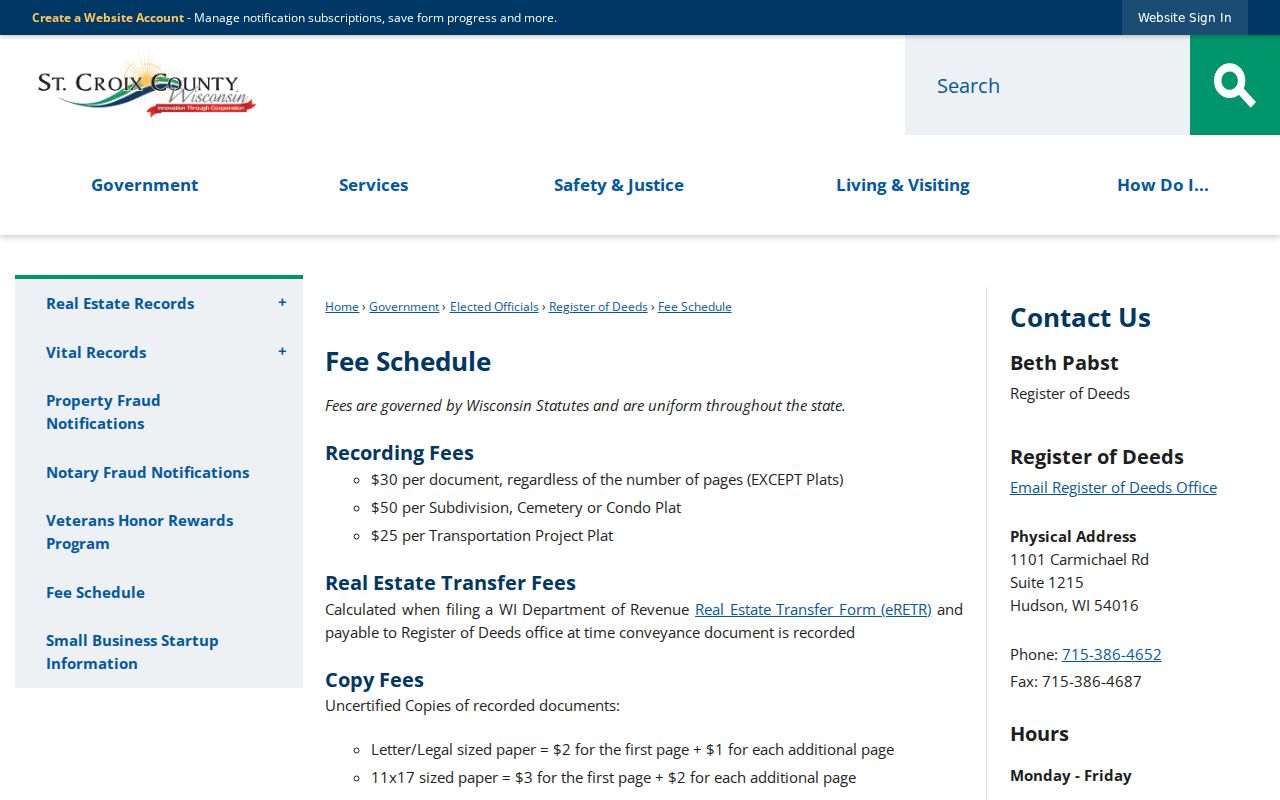
Note: Confirm the charge with the office whenever a request includes a large plat or a certified document.
Older St. Croix County Deed Records
The county's pages do not state the oldest online deed year. They also omit the imaging cutover and the full microfilm inventory. A missing result is not proof that an earlier transfer went unrecorded. Call the Register of Deeds and ask about grantor-grantee books, tract indexes, deed books, microfilm, or historical plat references. If the parcel description has shifted, use the modern parcel number to obtain the current legal description. Then compare the older section-township-range or lot wording. Electronic intake grew over time. County budget figures show 11,261 e-recorded documents in 2024 and 10,413 in 2023. Those came in alongside paper recordings. The numbers describe intake volume, not when scanned records became searchable online. Historical clues may also surface through Wisconsin Historical Society, State Archives, or FamilySearch catalog material.
St. Croix County Deed Filing Alerts
St. Croix County offers a free Property Alert Notification System. Register a name and the service sends a notice when that name is indexed in land records. An alert has limits, though. It cannot block a filing, confirm that a notice concerns the right parcel, or replace review of the actual instrument. The county directory lists 1-800-728-3858 for the service.
Watch for mail offering an expensive "official deed." The Register of Deeds publishes its own fee schedule, and that schedule settles what a real copy costs. If a filing surprises you, call the office directly. Compare the parties, document number, and legal description before acting. Enrollment in the alert service is handled online.
Open the St. Croix County property alert signup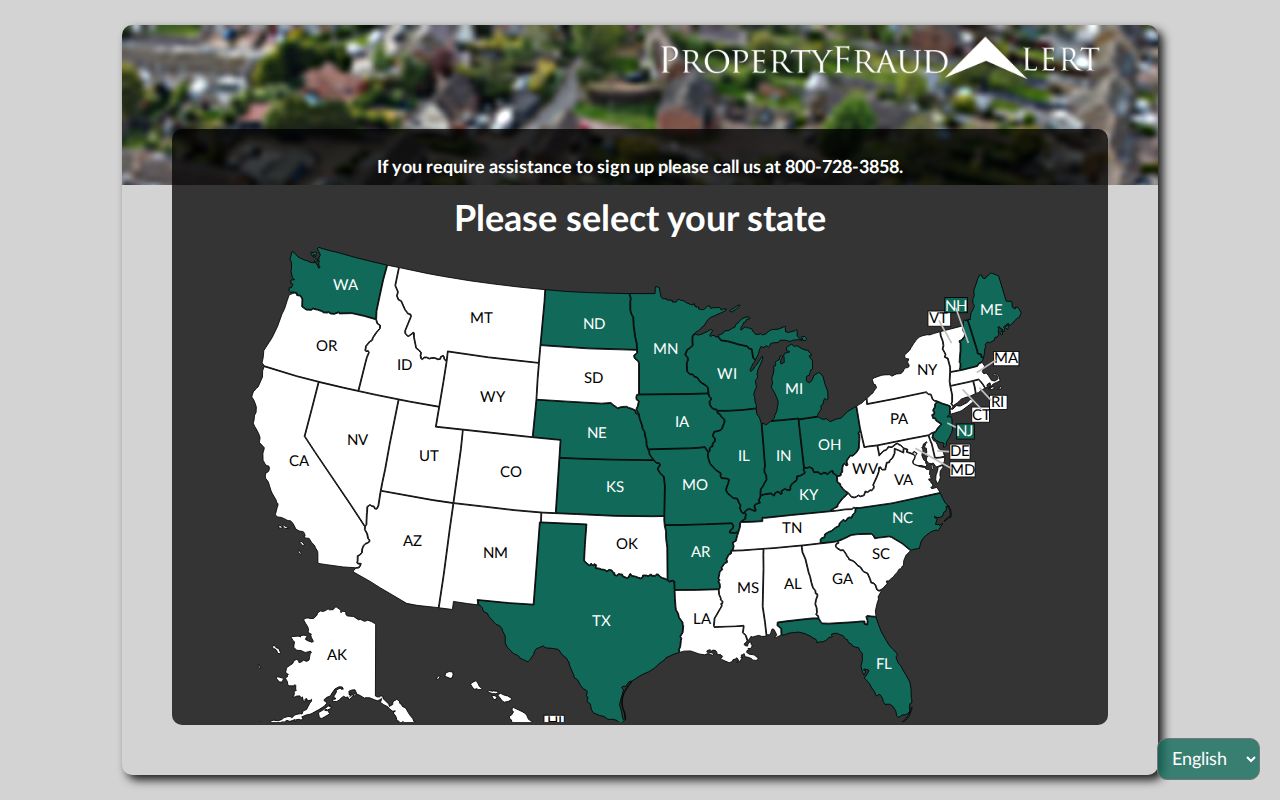
An alert is a prompt to inspect a record, not a determination about ownership.
Getting a Copy of a St. Croix County Deed
Need a copy of a St. Croix County deed? Start with the online vendor index, then confirm the official route with the Register of Deeds. The office sits in Suite 1215 at 1101 Carmichael Road in Hudson, keeps weekday hours of 8:00 a.m. to 4:30 p.m., and answers at 715-386-4652.
Put the details in writing. A request should name the parcel or the parties, the instrument type, the approximate date, and any recording reference. Recording payments can go by cash, check, or credit card. Make checks payable to Register of Deeds.
Recorded, not guaranteed. An index entry or vendor image may differ from the document held by the office. The county says online land records should not be relied on for title or foreclosure determinations; obtain an official copy and use a title professional for that work.
Check a St. Croix County Deed Chain
Every transfer question starts with the parcel. Pull the current parcel record and write down the names on it. Search the Register of Deeds index for those parties and the rough transfer period, then compare the instrument's legal description against the tax parcel. Names alone are not enough. One deed can convey a partial interest, correct an earlier description, or carry a trust or estate name that differs from the name on the current bill. Never assume a name match means the same land.
The land-record system holds more than deeds. Mortgages, satisfactions, liens, plats, and certified survey maps all live there, each for a different purpose. A mortgage records a security instrument. A satisfaction records its release. Neither one alone proves a title chain free of other claims. A plat or CSM explains how a lot was laid out, and the assessment roll and GIS map tie that layout to today's parcel number.
Online indexes end somewhere. The county does not publish the oldest searchable year, so ask the Register of Deeds which older book, microfilm, grantor-grantee index, or tract reference covers your era. Give staff the essentials. Name the parties, the property description, the approximate date, and the document type. Split parcels need extra care, so supply the parent parcel along with the current number to keep the earlier chain in view.
Decide what kind of copy you need. An uncertified office copy often suffices. Some institutions require certification, though. The published fee schedule separates letter-size from 11-by-17 copies and adds a certification charge. Choose the official document when the vendor image is incomplete. A hard-to-read legal description or a purchase or boundary decision also points that way.