
What St. Croix County Property Tax Records Show
A St. Croix County property tax bill tells two stories at once. One is the parcel's value. The other is the amount actually owed. St. Croix County property tax records keep those figures separate, since the assessed value feeds the tax process while the final bill reflects district levies, credits, and how you choose to pay. A sample 2023 Town of Star Prairie bill illustrates the layout. It lists land and improvement values, a total assessed value, an average assessment ratio, the First Dollar Credit, the Lottery and Gaming Credit, the net tax, and full or installment amounts. That example covers one town in one year. It is not a current county-wide rate or value.
| Field | What It Shows | Where |
|---|---|---|
| Land and improvements | Separate assessed portions that add to the total shown for that tax year | Sample tax bill / assessment record |
| Assessment ratio | Ratio printed on the bill; the sample reports 0.6678 | Sample bill |
| Credits | First Dollar Credit and Lottery and Gaming Credit in the sample | Tax bill |
| Tax amount | Net tax, full payment, and installment amounts | County or municipal treasurer |
| Payment status | Current balance and payment information | Catalis public portal or treasurer |
The assessed figure does one job. It drives the tax math for the parcel. It is not a current sale price, an appraisal, or any promise of what a buyer might pay, so treat it as a tax number rather than a market number. Keep two more cautions in mind. A bill's legal description may be abbreviated, and every value on it belongs to the printed year. For the meaning of the value fields rather than the payment process, see the St. Croix County property value explanation.
St. Croix County Tax Portal Fields
The Catalis instructions lay out three alternative search keys. You use just one per attempt. Guest Sign In covers searching and viewing. Checkout is a separate step for selected parcels and payment, capped at ten parcels per transaction. Fees sit at the payment stage, not the search field. The payment provider charges a $1.50 e-check fee. It also applies a 2.99% debit or credit card fee.
| Portal field | What to enter | Practical note |
|---|---|---|
| Parcel # / Property # | Parcel identifier | The county FAQ says the map can accept a no-dash form. |
| Owner (Last and First Name) | Name in last and first order | Enter less when unsure; check the parcel location. |
| Address (House # and Street Name) | Property street address | Do not substitute the owner's mailing address. |
| Search / record selection | One key, then choose a result | Cart and checkout are later steps. |
The Catalis search page is the direct public entry point. The portal keeps guest access separate from staff login. If online access fails, call the county Treasurer at 715-386-4645 or the municipality collecting the parcel's taxes. Payment can also be mailed, dropped in the county drop box, or made in person.
Open the St. Croix County public tax portal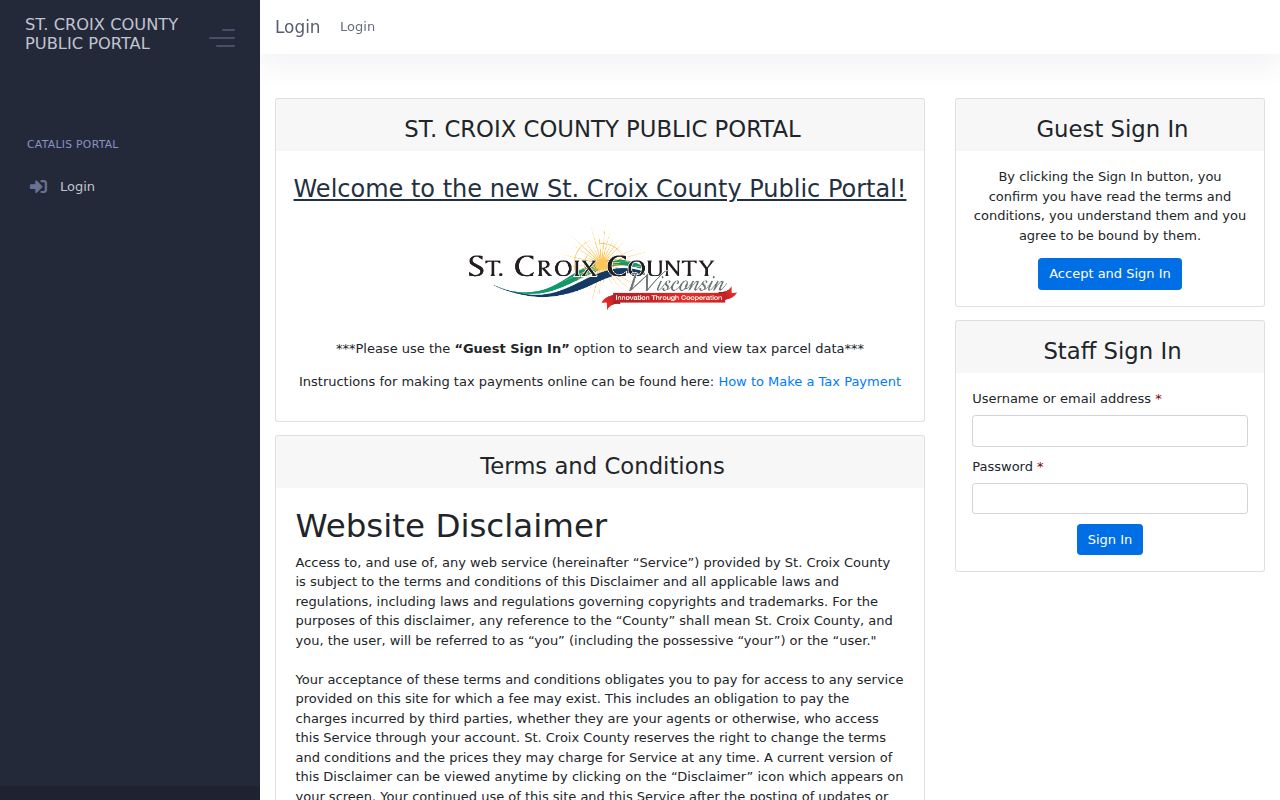
Guest Sign In opens the public parcel search.
St. Croix County Bill Timing
St. Croix County mails its tax bills in mid-December. The statement goes to whoever is the owner or taxpayer on record at that moment. Because taxes are collected in arrears, the county sets January 31 for full payment or the first installment, with July 31 for the second. A later transfer triggers no new bill. That lag explains why a parcel search and a paper bill can show different names or mailing addresses.
The County Treasurer collects for 18 municipalities. Check the municipality and tax year first. Payment options include online service, mail, a drop box, and in-person visits. Catalis sends checkout to Value Payment Systems. Its listed card and e-check charges are vendor fees, not part of the tax amount itself.
Missing a bill does not erase the tax. Wis. Stat. § 74.09(6) makes that clear, as the county tax page notes. Keep the receipt and payment confirmation with the parcel record.
The Treasurer page describes its county role and contacts.
See St. Croix County Treasurer information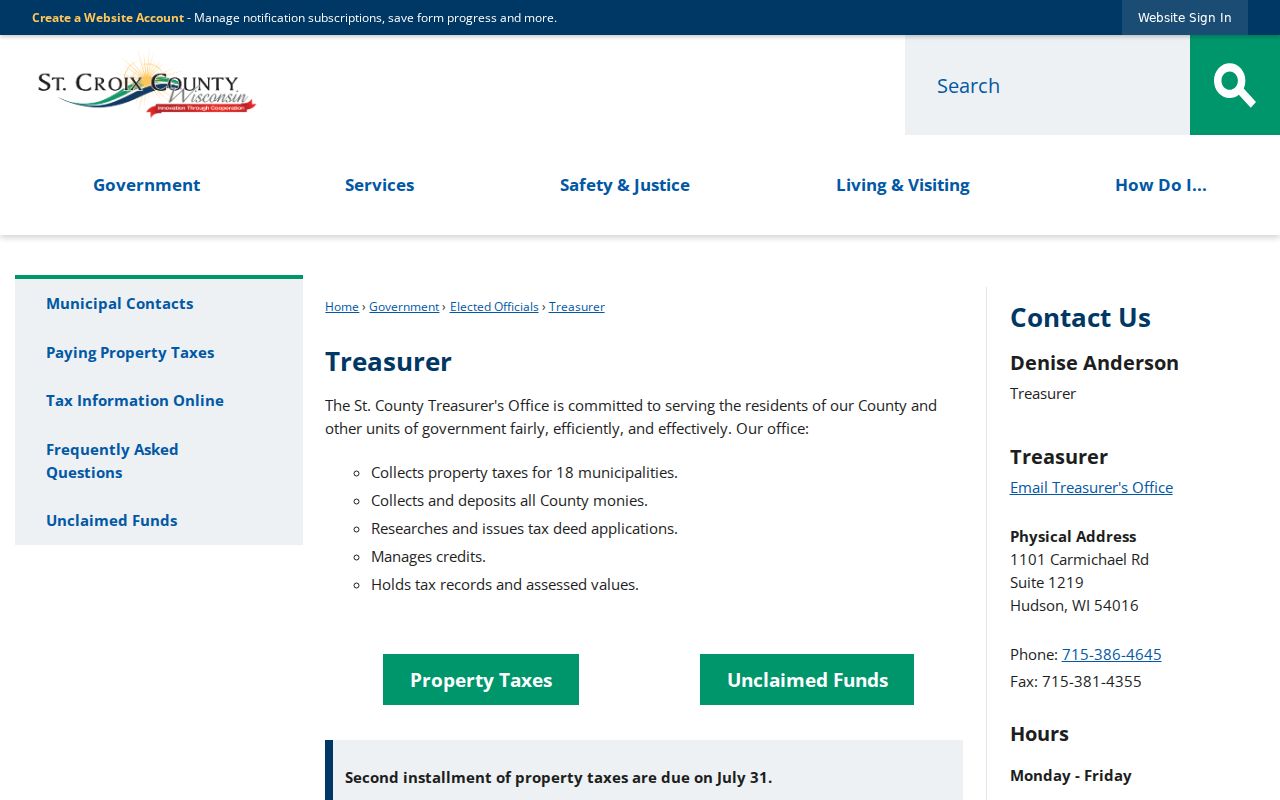
A bill that conflicts with the current owner field deserves a closer look. Ask which account and tax year the statement covers.
Reading a St. Croix County Tax Bill
A 2023 Town of Star Prairie bill makes a clear field model. The record ties the parcel to Section 13, Township 31 North, Range 18 West, and the SE quarter of the NW quarter. It also names parcel 038-1193-10-000, alternate parcel 13.31.18.996, 1.800 acres, Pine Acres 2000, and Lot 1. Copy every clue together. A street address alone falls short.
The value section lists $29,600 for land, $171,800 for improvements, and $201,400 total assessed value. The average assessment ratio is 0.6678. Credits and payment lines then shape the final tax due. Never treat these sample amounts as a benchmark for another parcel. The bill also warns that its property description may not be a full legal description. A deed, plat, or survey settles exact boundaries.
Looking Up a St. Croix County Tax Bill
A St. Croix County tax bill starts with the Catalis public tax portal. The best search key is the parcel number. An address or an owner name will work too. The portal asks you to enter just one criterion at a time. Before you compare balances across parcels, confirm the tax year on each bill. Confirm the municipality listed as well. Keep an eye on the owner field. The tax bill is an account document. If a parcel changed hands recently, the name on it may still reflect the prior owner of record.
- Search by parcel number, owner last and first name, or house number and street name.
- Confirm the municipality and tax year, then read the bill and payment status.
- Compare credits and assessed-value components with the parcel record.
- If delinquent, review county tax-deed information and court filings before acting.
- Assessed value
- The recorded value used for tax administration, separate from the amount due.
- Credit
- A listed reduction that changes the net tax amount, such as credits shown in the sample bill.
- Installment
- A scheduled part of a bill; the county lists January and July due dates.
- Tax deed
- A county conveyance process for tax-titled parcels, governed by posted bid terms.
St. Croix County Delinquent Tax Records
St. Croix County sells tax-deeded property on strict terms. The Treasurer handles tax-deed applications. The County Clerk accepts sealed bids on listed parcels. Bidders submit a 10% deposit by cashier's check or money order. The winning bid must be paid in full within 30 days. After that final payment, the county issues a quitclaim deed.
Buyers give up a lot of protection. The county sells these parcels as-is, with no abstract and no title insurance. Investigating title, access, utilities, zoning, and survey needs falls entirely on the buyer. The notice lists a parcel number and legal description. Use them to pull the GIS layers and recorded liens. Use them also for any court filings tied to the land. Corner stakes may not exist on the ground, and surveying is the buyer's job. A posted appraisal is not market value and guarantees nothing about condition.
Note: These are specialized tax-deed terms, not routine tax-bill instructions. The tax-deed page sets out the bid process and its limits.
Review the St. Croix County tax-deed sale terms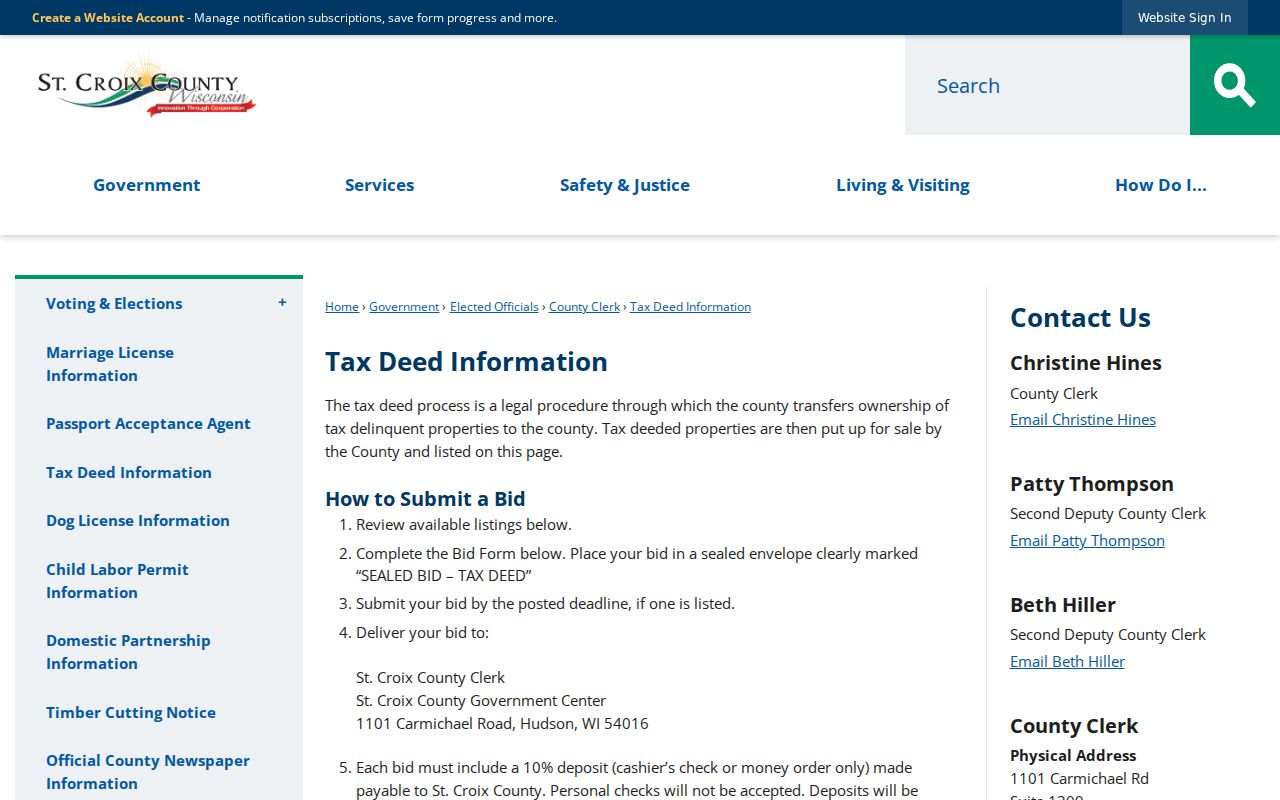
Read every posted condition before treating a delinquent parcel as an ordinary purchase.
Request St. Croix County Tax Records
Sometimes a portal simply omits the bill you need. Ask the Treasurer or the municipal custodian for a copy in that case. Wisconsin Public Records Law, Wis. Stat. §§19.31–19.39, permits oral or written requests, so a phone call can work. Give the parcel number, tax year, address, and the exact record you want. A custodian may charge actual, necessary, and direct costs for locating, copying, and delivery. DOJ guidance says locating costs generally must reach $50 before they can be charged. Prepayment can be demanded once a total passes $5.
Be precise about what you ask for. A custodian does not have to build a new report or answer an open-ended question. Request an estimate before authorizing a broad search of St. Croix County tax records. A written denial must state its reason and your review rights. The state sets no fixed response deadline for every request. Keep a copy of the request and the response, along with the tax year involved. The Wisconsin DOJ explains the access rules in detail.
Read Wisconsin Public Records Law guidance
A narrow request helps the office find the right bill and estimate any direct search cost.
Paying a St. Croix County Property Tax Bill
St. Croix County offers several ways to pay a property tax bill. Options include online, by mail, at a drop box, or in person. Read the bill first. Confirm the municipality, the installment amount, and the parcel number before choosing a route. The online provider adds a $1.50 charge for an e-check. It adds a 2.99 percent fee for a card. Those are vendor fees, not another county levy. Compare the final confirmation screen against the tax amount actually due.
The county collects taxes for 18 municipalities. The Treasurer's office sits in Suite 1219 at 1101 Carmichael Road in Hudson. The phone number is 715-386-4645. An assessment question or a municipal charge belongs with the local government named on the bill. Ask the Treasurer or Real Property Listing which office handles a given detail. The county payment route consolidates information without erasing the local jurisdiction on the account.
Online checkout caps a single transaction at ten parcels. Split the list if you are paying several accounts. Save each receipt with its parcel IDs. A receipt only proves a submission was made. If a payment never shows on the bill record, confirm it with the Treasurer or check the account history.
Appealing a St. Croix County Assessment
No single countywide appeal date fits every parcel. St. Croix County posts no confirmed assessment-review calendar, filing form, or universal deadline. A generic date will mislead you. Read the assessment notice itself. Contact the local assessor or review body named there to confirm the filing window, the evidence required, and the hearing steps. Keep the parcel number and tax year with any request.
Good evidence for a value discussion includes the assessment detail and the land and improvement components. Add the legal description and recent recorded conveyances for the same parcel. A tax bill shows what was charged after credits and levies were applied. It cannot, on its own, prove an assessment wrong. Preserve the written response and meet whatever date the proper office states.
Confirm the appeal window. The sources captured for St. Croix County did not establish a current deadline or board name. Use the date and instructions on the parcel's assessment notice, and call the issuing assessor before filing.